
Ice cream: is it a liquid, or a solid? On hot summer days, it is more the former, but when you are scooping (read: wrestling) it out of a container, it certainly feels like the latter. In our part of the world it has been a very cold winter with an average low of about -35 C/-31 F – very cold, very crispy cold indeed.
Since we are not ones to complain, we thought, what better way to enjoy the freezer we live in than to make ice cream in it?! So a couple weeks ago, armed with long underwear and a wooden spoon, we set about making two versions of some good old fashioned vanilla ice cream: one with just vanilla (for the kids), and another with a spike of bourbon (for the kids at heart). It has since warmed up slightly (-15 C, hoorah!) and some of the birds are chirping again, but until the ground completely thaws, we are enjoying some winter-made ice cream next to our sputtering radiators.
Vanilla ice cream
- 1 cup homogenized milk (3%)
- ¾ cup white sugar
- 2 cups heavy cream (35%)
- 1 vanilla bean
- 6 egg yolks
- 1 tsp vanilla extract
The creation of ice cream starts with making a custard: begin by warming the milk, sugar, and 1 cup of the cream in a small saucepan until the sugar is dissolved.

Meanwhile, split the vanilla bean open lengthwise and scrape out the seeds using the edge of your knife. When the sugar is dissolved, take the pan off the heat and add the vanilla seeds and pod. Cover, and let it steep for about 30 minutes. Remove the vanilla pod and rinse with some water. Let it dry and save it for something else: infusing sugar, making your own vanilla extract, decorating a gingerbread house, etc.

Pour the remaining 1 cup of cream into a large bowl, and set a fine-mesh sieve on top. Whisk the egg yolks together, and add it to the saucepan’s milk mixture. Put the pan back on the stove over medium heat, and continually stir with a rubber spatula to ensure that the custard doesn’t stick to the bottom or the yolks curdle. Continue to heat until the mixture thickens and coats the back of a spoon (or hits about 75 C/170 F). Pour the custard through the sieve into the cream. Add the vanilla extract, and stir to mix thoroughly. Chill in the fridge overnight.


To make a grown-up only ice cream, add a single shot (42 ml/1.5 oz) of your favourite bourbon to the above recipe when you add the vanilla extract. David prefers Knob Creek Small Batch Bourbon. Another option is to split the above recipe in half, keeping one half alcohol-free, and adding half a shot to the other.
The key to making a smooth ice cream is to have the custard as cold as possible before freezing, so that the water molecules in the custard can freeze quickly – the faster water freezes, the smaller the ice crystals, resulting in a smooth texture. Water that freezes slowly makes bigger crystals, which the tongue would perceive as a sandy texture – how undesirable! Thus the overnight chill in the fridge is an important step in making good ice cream. After that, it is time to freeze the custard to convert it to a magical substance known as ice cream. You can certainly place the bowl of custard in the freezer in your kitchen – but since it has been an average of -30 C (-22 F) for the past few months, we took our bowls outside. It was a pretty chilly time, but well worth the wait.


At -30 C, the ice cream took about 2 hours to firm up. Alcohol lowers freezing point, so the bourbon version took a little longer. Afterwards we transferred the ice cream from bowls to Tupperware for easier storage.
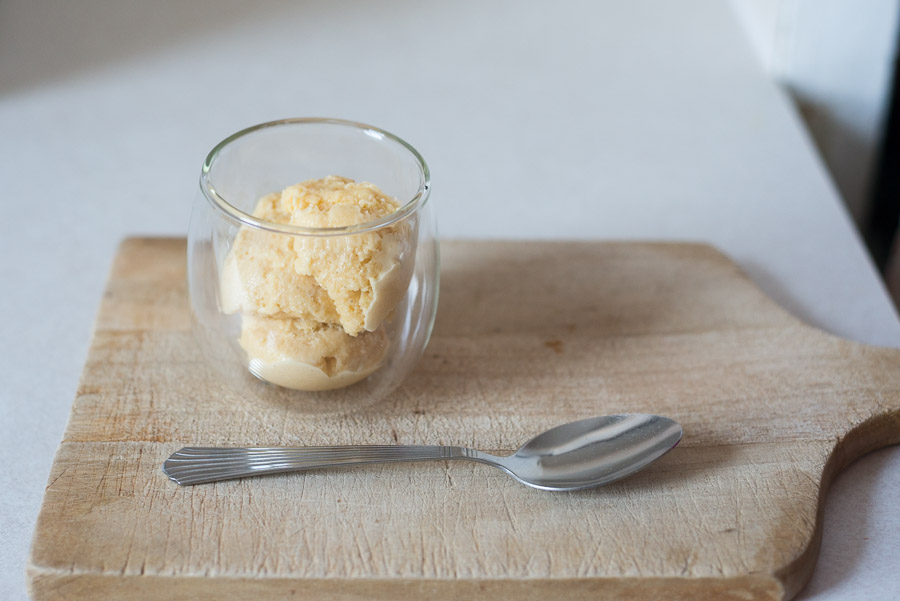
One of my childhood friends said that eating ice cream in the winter will make you warmer, because it drops your internal body temperature so that the outside air feels comparatively warm. I’m not sure that is totally accurate, but ice cream is mighty tasty in all seasons, especially when you make it yourself.